Thursday, June 4, 2026
Why did this complaint occur? Using the Fishbone Diagram and 5 Whys to strengthen complaint handling

In this article, we're going to discuss:
Why recurring complaints need root cause analysis
If the same issues keep resurfacing, there’s a deeper cause that’s being missed. On the surface, it can look like a staffing problem, a training gap, or a one-off error. But when good people keep working hard and the same complaints still come back, the problem is often built into the process itself.
This is why root cause analysis matters. It helps complaint teams move beyond the visible symptom and understand what is really driving repeat dissatisfaction, avoidable escalation, missed regulatory deadlines, or inconsistent decisions. Instead of asking only what went wrong in one case, it asks why the issue keeps happening at all.
In regulated complaint handling, this matters even more. Repeat complaints can be an early sign that something is not working as intended, whether that is a weak hand-off, unclear ownership, poor communication, or a control that looks fine on paper but fails in practice. Fixing complaints properly means identifying the underlying cause, not just dealing with the latest version of the same problem.
One combination that has helped me do that more than once is the Fishbone Diagram and the 5 Whys. Used together, they help teams step back from the noise, organise their thinking, and get clearer on what needs to change.
What is a Fishbone Diagram?
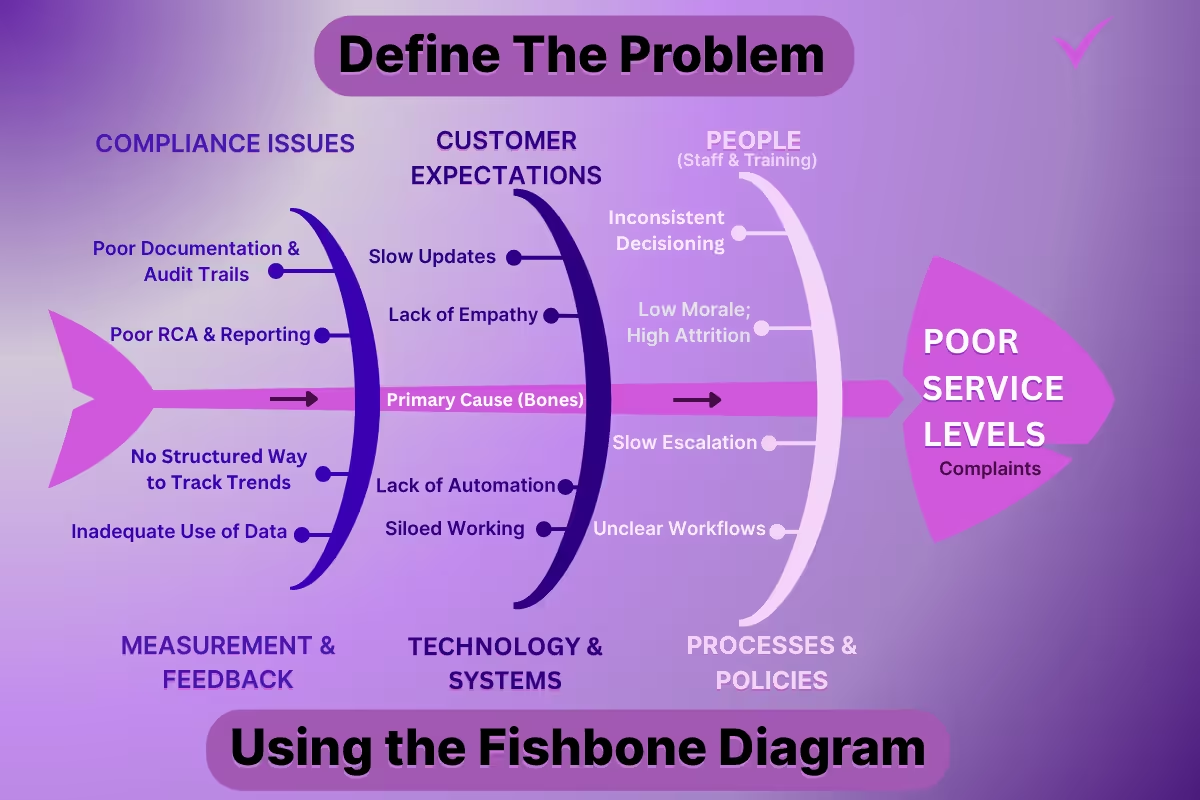
The Fishbone Diagram, also known as the Ishikawa Diagram or Cause-and-Effect Diagram, is a visual tool used to systematically identify and organise potential causes of a problem. It resembles the skeleton of a fish, with the problem statement at the head and the causes branching off like bones. The diagram helps teams break down complex issues into manageable parts and explore contributing factors across different categories.
What are the 5 Whys of root cause analysis?
The 5 Whys is a root cause analysis (RCA) method that helps teams move from the visible complaint issue to the underlying reason it occurred. By asking “why?” repeatedly, usually around five times, the team can explore the chain of events and identify the process, control or system weakness that needs to change.
Five is a guide rather than a fixed rule. Some investigations reach a useful root cause sooner, while more complex complaints may need further questions or more than one line of investigation.
Using the 5 Whys method to find the underlying systemic cause of a complaint
Most complaints have an obvious trigger. But the trigger is usually the symptom, not the real underlying cause.
In practice, this matters because complaint teams don’t struggle with one-off errors. They struggle with repeat patterns: the same delays, the same handoffs, the same inconsistent decision making, and the same avoidable escalation risk.
You’ll often hear people jump straight to the 5 Whys. But in complaint handling, the best results usually come from doing one step first: mapping the possible drivers using a Fishbone Diagram. Then you apply the 5 Whys to the most likely causes.
Step 1: Use a Fishbone Diagram to map what is driving the complaint
What does a Fishbone Diagram help you identify?
During the Analyse phase of improvement work (e.g. DMAIC: Define, Measure, Analyse, Improve, Control), a Fishbone Diagram helps you:
break a complaint problem into manageable parts
explore possible contributing causes
move beyond assumptions and surface-level explanations
identify where supporting data or further investigation is needed
organise the team’s thinking before applying the 5 Whys
I’ve given Fishbone templates to complaint teams and asked them to add to them over 48 to 72 hours while handling live cases. There’s nothing like working on a real-life problem to trigger the mind!
Quick definitions for root cause analysis in complaint handling
Before starting the exercise, agree on what each term means:
Complaint issue: what the customer is unhappy about, such as a delay, incorrect information or poor communication
Symptom: what the team can see happening, such as repeat contact, missed deadlines or rising FOS referrals
Trigger: the event that prompted the complaint, such as a missed callback, an unclear letter or a delayed decision
Contributing cause: something that helped create the problem, but may not explain why it keeps recurring
Root cause: the underlying process, system, control or ownership failure that allows the problem to happen repeatedly
Corrective action: what the firm changes to deal with the immediate problem
Preventive action: what the firm puts in place to reduce the risk of the same problem happening again
When to use a Fishbone Diagram in regulated complaint handling
FCA rules require firms to identify and remedy recurring or systemic problems revealed by complaints. Consumer Duty also expects firms to monitor customer outcomes, identify where harm may be occurring and act when products, services or processes aren’t working as intended.
The FCA doesn’t prescribe the Fishbone Diagram as a mandatory method. It’s one practical way to organise possible causes, test assumptions and support a more structured root cause investigation.
The Fishbone Diagram is a great way to do this. Use it when:
the same issue keeps resurfacing and you need to find the cause (e.g. repeated complaints about the same thing, missed SLAs)
complaints are being resolved internally but customers are still escalating them to FOS
there’s disagreement in the team about what’s going wrong
you need to highlight what’s behind recurring issues
you need to investigate and correct recurring or systemic issues
Example: poor service levels
Let’s say service levels are dropping. You can use a Fishbone Diagram to map possible causes across six complaint handling categories:
People: high turnover, low morale, knowledge gaps, inconsistent decisions or limited authority
Process and policy: unclear ownership, unnecessary approvals, weak handoffs or no escalation route
Technology and data: manual logging, siloed systems, poor case visibility or unreliable information
Product and service design: processes that don’t work as intended, unsuitable service features or unnecessary complexity
Communication and customer understanding: unclear letters, inconsistent updates, poor explanations or information provided at the wrong time
Governance, controls and third parties: weak oversight, ineffective quality assurance, supplier failures or controls that don’t work in practice
Once you’ve mapped the possible causes, you can apply the 5 Whys to the areas most likely to be driving the problem.
Step 2: Use the 5 Whys root cause analysis
Once you’ve mapped the possible causes using the Fishbone Diagram, choose the areas most likely to be driving the complaint problem. The 5 Whys helps you explore each one in more detail and move from an initial explanation to the process, control or ownership failure underneath it.
select a complaint issue to investigate
ask 'why' the issue is happening
analyse the response and ask 'why' again
continue asking 'why' until you reach a useful root cause, usually within five questions or fewer
identify the corrective and preventive actions required
I’ve used this approach with regulated complaint teams when service levels dropped, FOS escalations increased, or complaints kept bouncing between case handlers with no clear ownership.
How the Fishbone Diagram and 5 Whys work together
The Fishbone Diagram helps the team identify several possible causes of a complaint problem. The 5 Whys can then be applied to the most likely cause to find out what is allowing the problem to continue.
Let’s look at an example:
Problem: bottlenecks are causing poor service levels and repeat complaints.
Why are complaints being delayed? They’re sitting in referral queues waiting for approval
Why are so many cases being referred? Case handlers can’t close certain complaints without team leader approval
Why is team leader approval required? The approval rules apply to all complaints, regardless of complexity or risk
Why were the rules designed this way? The process was created to reduce financial risk, but it hasn’t been reviewed against current complaint volumes or case types
Why hasn’t the process been reviewed? No one owns the approval framework or monitors whether it is creating avoidable delays
Root cause: there is no clear ownership or review process for the approval framework, so outdated controls continue to create unnecessary bottlenecks.
Corrective action: review the approval rules and remove unnecessary referrals for straightforward or low-risk cases.
Preventive action: assign ownership of the approval framework, introduce clear approval thresholds and monitor referral volumes, resolution times and control outcomes.
💡Tip: Split the team into two or three smaller groups and give each one a problem and a Fishbone Diagram. Ask them to add to it over a day or two, then apply the 5 Whys to the strongest possible causes and compare their findings.
Fishbone Diagram categories for complaint handling
What are the 6 elements of a Fishbone Diagram for complaints?
For regulated complaint handling, these six categories provide a useful starting point:
People: high turnover, low morale, knowledge gaps, inconsistent decisions or limited authority
Process and policy: unclear ownership, unnecessary approvals, weak handoffs or no escalation route
Technology and data: manual logging, siloed systems, poor case visibility or unreliable information
Product and service design: processes that don’t work as intended, unsuitable service features or unnecessary complexity
Communication and customer understanding: unclear letters, inconsistent updates, poor explanations or information provided at the wrong time
Governance, controls and third parties: weak oversight, ineffective quality assurance, supplier failures or controls that don’t work in practice
These categories aren’t fixed. You can adapt them to suit the complaint issue, product, service or operating model you’re reviewing.
How do FCA complaint categories map into root cause analysis?
The FCA complaint taxonomy helps firms record what the complaint was about, such as a delay, an error, poor information or a problem with a product or service. This is useful for consistent regulatory reporting, but the complaint category isn’t always the root cause.
For example, a complaint may be recorded under delays or timescales, but the underlying cause could be an approval bottleneck, unclear ownership, a system failure or a third party delay.
A useful approach is to record both:
FCA complaint category: what the customer experienced or complained about.
Internal root cause category: the process, system, control, communication or governance failure that allowed it to happen.
This gives firms the information they need for FCA reporting while preserving the detail required to prevent the same problem from recurring. A single FCA complaint category may map to more than one possible root cause, so the investigation shouldn’t rely on the reporting label alone.
What are the seven Ps of a Fishbone Diagram?
For service-based businesses, the seven Ps can provide a more relevant alternative to the traditional manufacturing categories associated with the Ishikawa model.
People
Processes
Physical evidence
Placement
Product
Promotion
Price
These categories can work well in financial services because they reflect the customer journey, service delivery and product environment more closely. You don’t need to use all of them, and you can adapt the categories to match the complaint type, product, service or operating model you’re reviewing.
Fishbone Diagrams are used across several sectors, including healthcare and financial services. NHS England includes them within its quality improvement resources as a way to explore possible causes, move beyond symptoms and identify where further investigation is needed.
How to create a Fishbone Diagram in Word
You don’t need specialist software to create a Fishbone Diagram. Word is enough for a simple team exercise, particularly when you want to document the discussion, share it with colleagues or keep it as evidence of the root cause investigation.
Open a blank document
Use Insert > Shapes to draw a horizontal arrow
Add text boxes branching off the spine
Label with your chosen categories
Add contributing causes under each
Getting started with a Fishbone Diagram
Before the session begins, agree on the problem you’re trying to understand. A clear problem statement helps the team stay focused and stops the discussion from becoming too broad.
Use your Word template, or draw a Fishbone Diagram on a whiteboard or piece of paper
Write the agreed problem statement clearly at the 'head' of the fish
Choose the categories that best fit the complaint issue
Add possible contributing causes to each branch of the Fishbone Diagram
Use complaint data, case examples and team insight to test the ideas
Apply the 5 Whys to the most likely causes
Highlight the causes that need further validation or action
The aim isn’t to agree on a root cause during the first discussion. It’s to organise the evidence, challenge assumptions and identify where the investigation should go next.
Why use the Fishbone Diagram with the 5 Whys?
The two tools work well together because they do different jobs.
The Fishbone Diagram helps you look across the problem and organise the possible causes. The 5 Whys then helps you explore the strongest possibilities in more depth.
Used together, they can help teams:
map possible causes clearly
avoid jumping to the first explanation
test assumptions against complaint data and case evidence
identify where further investigation is needed
reach a root cause that can be acted on and monitored
This gives the team a more structured way to move from what happened to why it keeps happening.
Advantages of the Fishbone Diagram
A Fishbone Diagram can be useful because it gives teams a simple way to organise a complicated complaint problem. It can bring together different perspectives, make patterns easier to see and help the discussion move beyond the first explanation that comes to mind. It:
is easy to understand and explain
is useful when time is limited, or resources are scarce
helps simplify complex issues
is great for team collaboration and root cause sessions
sparks ideas even when you’re not sure where to start
provides a visual map you can return to
is visual and helps stakeholders remember your message
Disadvantages of the Fishbone Diagram
A Fishbone Diagram can be useful, but it has limitations:
it can become too broad or difficult to follow if the problem statement isn’t clear
it can rely too heavily on opinion if the team doesn’t test ideas against complaint data and case evidence
it identifies possible causes but doesn’t show which ones are most important
it can lead the investigation in the wrong direction if the categories aren’t well chosen
it may oversimplify a complaint problem that has several connected causes
The diagram should be treated as the start of the investigation, not proof that the team has found the root cause. Use complaint MI, case reviews, quality assurance findings and operational evidence to validate what appears on it.
Why root cause analysis matters in FCA-regulated complaint handling
Root cause analysis helps firms understand whether a complaint points to a wider weakness in a product, process, system or control. FCA rules require firms to identify and remedy recurring or systemic problems revealed by complaints, while Consumer Duty expects them to monitor customer outcomes and act when harm or poor outcomes are identified.
Used properly, RCA gives firms a clearer view of what needs to change, who should own the action and how they’ll check whether the fix has worked.
Key reasons why RCA matters:
repeat complaints can point to a recurring or systemic issue rather than an isolated mistake
RCA creates a clearer record of what caused the problem and what action was taken
teams can move from repeatedly resolving the same issue to preventing it
stronger complaint MI supports better operational and leadership decisions
RCA can reduce avoidable escalation and support Consumer Duty outcome monitoring
complaint data can show whether products, services and processes are working as intended
analysis can help firms identify whether particular customer groups, including customers with characteristics of vulnerability, are experiencing poorer outcomes
better controls and oversight can reduce unnecessary cost, rework and pressure on complaint teams
Complaint management toolbox
Fixing a complaint problem starts with understanding what’s broken, rather than only dealing with what’s visible.
The Fishbone Diagram and 5 Whys give teams a practical way to organise possible causes, challenge assumptions and decide where the investigation needs to go next. They won’t replace good complaint data, case reviews or quality assurance, but they can help teams use this evidence more effectively.
You may also find our guide, The 5 Cs of complaint handling and how to use the framework effectively, useful when strengthening the wider complaint handling process.
Make root cause analysis easier to evidence
Root cause analysis is much harder when complaint information is spread across spreadsheets, inboxes and separate documents.
Complyr’s complaint case management software keeps case notes, documents, evidence, actions and decision rationale together in one structured complaint record. This gives teams a clearer foundation for identifying recurring issues, recording root causes and showing what action was taken.
See how Complyr can support your team to make root cause analysis easier to evidence.